|
The other day I subscribed to a streaming jazz channel via Amazon Prime (yes, I understand Amazon is the quintessence of evil but it's also something I've come to rely on). I'm not going to give them free advertising here, but if you're interested, it's easy enough to find on the Amazon Prime site. The channel mostly comprises videos by young European musicians, some of them quite good or at least interesting. However, I was mostly attracted to the fair number featuring jazz greats of yesteryear: Mingus, Dolphy, Coltrane, Hawkins and more ... it's not a comprehensive list, but there's enough to keep you engaged for an hour or so, here and there.
It occurred to me while I was watching a 1960s Belgian performance by Rahsaan Roland Kirk that, as a jazz lover, I've been especially lucky. I thought about how I never got to see Kirk in concert, which in turn got me thinking about all the great musicians I have seen. In fact, it's almost as easy to name greats who I didn't get to see, as those I did. I didn't see Kirk, but I saw Dexter Gordon. I didn't see Coltrane, but I saw Ornette (in fact, I got to jam with him in his home a couple of months before he died). I didn't see Paul Desmond, but I studied with Lee Konitz. (I even jammed with him in his Manhattan apartment: I played soprano, with pianist Yuko Fujiyama ... and Lee on drums!) You get the idea. I saw Chet Baker, Clark Terry, Miles Davis, Phil Woods, Count Basie, Fitzgerald, Weather Report, Michael Brecker, Stan Getz, Ray Charles, Oscar Peterson, Milt Hinton, Woody Herman, and others I've probably forgotten ... all before I moved to New York in 1986. After I moved to New York, well, the list is so long, I'll just hit some highlights: Sonny Rollins, Cecil Taylor (whose rehearsal big band I played in, circa 1996 or so), World Saxophone Quartet, Julius Hemphill Sextet, Evan Parker, Sun Ra, Don Cherry, Dave Liebman, Paul Motian, Max Roach, Anthony Braxton, Lew Tabackin, Ronald Shannon Jackson, Art Ensemble of Chicago. And so many others. That's not to mention all the lesser-known but exceptional musicians I've had the good fortune to play with over the years. I don't mean this to sound like a humble brag. That I was born when I was and lived in an age when so many great jazz musicians of different eras walked the earth simultaneously owes nothing to me. It was just luck. It's something to think about when I'm taking inventory of my life. All in all, it's been pretty, pretty, pretty good.
0 Comments
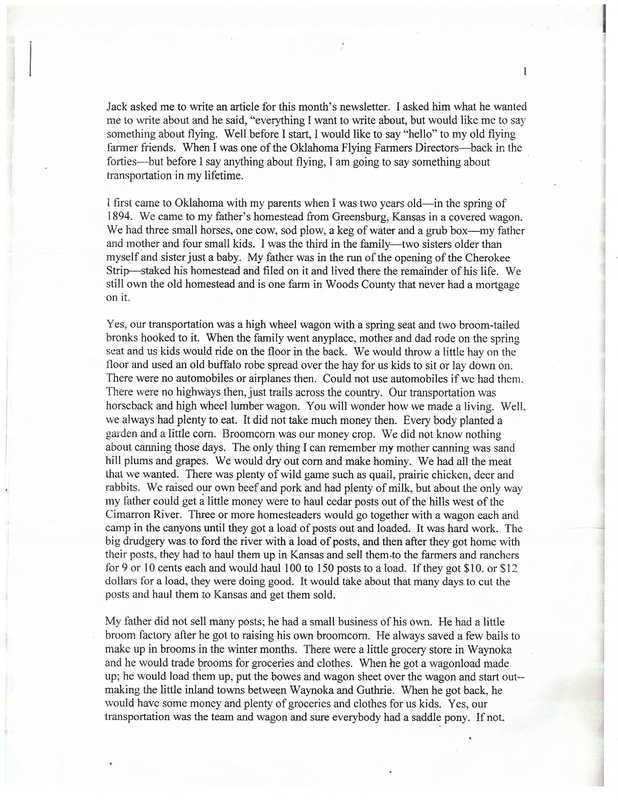
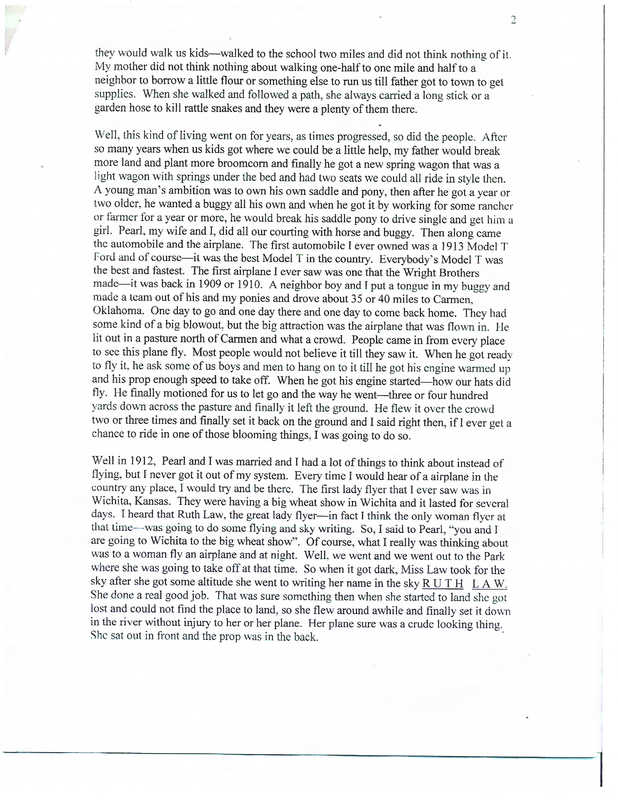
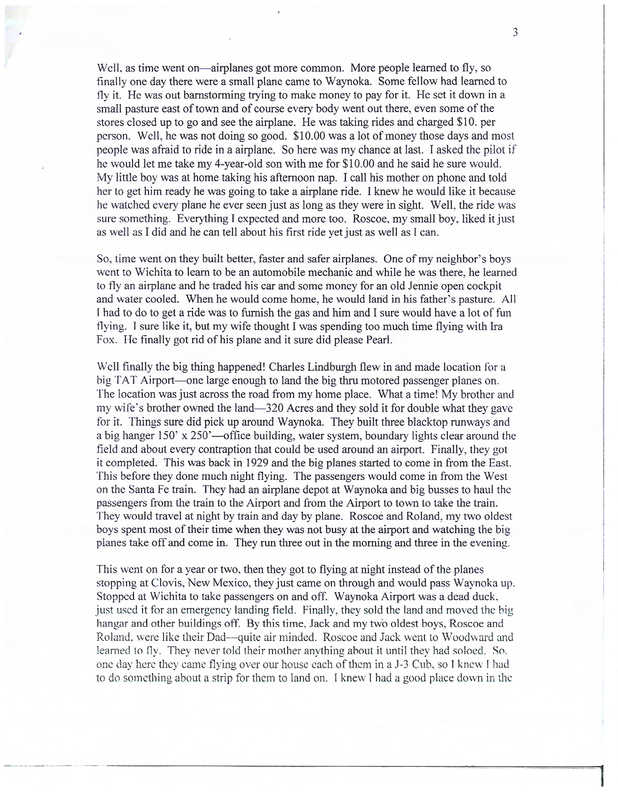
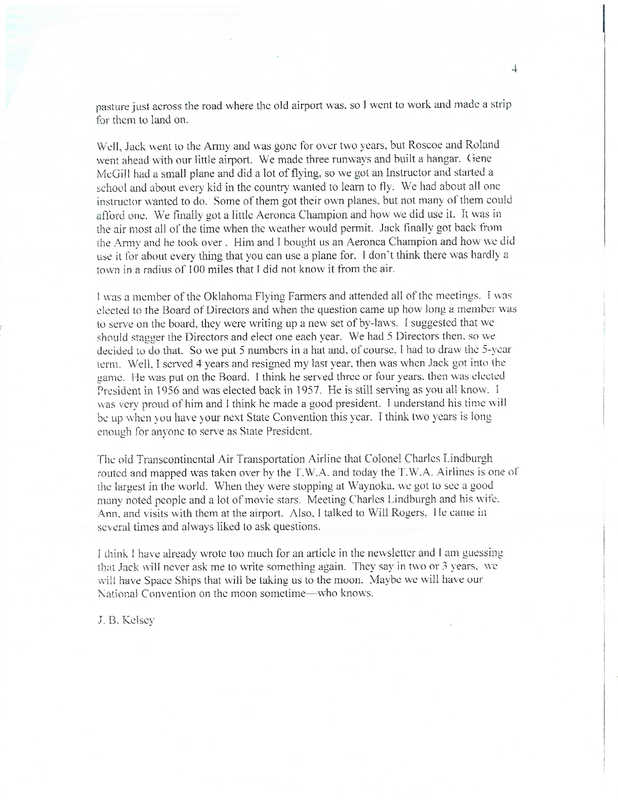
The following document is a copy of the original manuscript from an article my great grandfather J.B. "Bunk" Kelsey wrote for the Oklahoma Flying Farmer newsletter in 1957. "Jack" in the article refers to Jack Kelsey (my grandfather Roland Kelsey's brother and my great uncle), who was president of the state organization at the time. (If you want to know what the Flying Farmers are, click here.) More than just a fascinating personal history, this document gives you a sense on what Oklahoma must've been like for a young farmer who witnessed the birth of the state, stuck with it through the Dust Bowl and Great Depression, and saw it finally come into its own. Along the way he crossed paths with such famous pilots Charles Lindbergh and Ruth Law, and the first airplane he ever saw was was made by the Wright Brothers! I think this is incredible stuff. I thank my father Barry Kelsey for letting me post it here. If you can't read the jpeg, I've included a download link to the pdf. 
    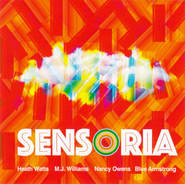 These days, when I have a CD I want to listen to without being distracted, I tend to do it on long drives. Last night on my way back from Albany, I listened to Sensoria (Leo Records), a CD by a group comprising soprano saxophonist Heath Watts, violinist Nancy Owens, trombonist M.J. Williams, and bassist Blue Armstrong. In general, one of the great things about free improv is the infinity of possibilities—each different combination of musicians invariably creates something unique. Better still if that group listens hard and works together sans ego and with a sense of common purpose. That happens here. A multiplicity of colors, lines, and textures defines this music, as does a tender attention to spontaneous detail. For some reason, as I listened, it occurred to me this music could be the soundtrack to a painting by Phillip Guston. I'm sure I can't explain why and wouldn't want to try, but hours later, I'll stand by that description. I'd like to thank Heath (whose playing evidences an amazing variance of timbre and attack and sheer imagination) for sending this my way. A more attractive album of non-idiomatic free improvisation would be hard to find.
 For most of the last twenty years, I've downplayed my status as a writer, mainly because I considered myself primarily a jazz musician. Since I wrote jazz criticism, I didn't want my secondary activity interfering with my first. That was an exercise in futility or naivete, take your pick. There was no way I could do one without having it affect the other, and of course my divided loyalties led to many conflicts. A few years ago, I essentially stopped writing altogether, after having angered one musician so much, he began cyber-stalking me and trying to hack my website. Making enemies is exhausting, especially if it inevitably happens by accident and you don't have a taste for conflict. It did and I didn't, so I stopped.
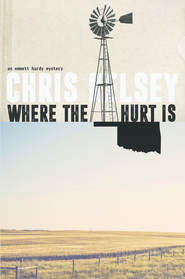
At the time, I figured that to stop writing about jazz meant to stop writing completely. Except for occasional political blogging and the odd lengthy Facebook post, that was the case for quite a while. That is, until I realized I had something to say that couldn't be said through the bell of a saxophone. Three years ago, I started a novel. The working title was An Ocean of Fireflies, but an agent told me she thought I needed something less poetic, given the nature of the book. I agreed, and changed the title mid-novel to Where the Hurt Is. So it remains, three months prior to publication. The story is set in a small fictional Oklahoma town in 1965. The protagonist is the local police chief, Emmett Hardy (a name with musical connotations, as the savviest jazz fans will recognize). I've long been a fan of noir, both the film and print varieties. Hardy's a compendium of all the literary cops and private eyes I've loved over the years, from Sam Spade and Phillip Marlowe to Bernie Gunther and John Rebus, not to mention my two favorite Harrys: Bosch and Hole. And many others. Emmett shares certain of those characters' positive qualities and as many flaws, except instead of policing an urban area, he works in a town of less than 2000 people, located far from anything like a good-sized town, never mind a city. That's where my love of another character—the Legendary Lieutenant Joe Leaphorn, created by my fellow-Okie Tony Hillerman and kept active long past retirement age (and thank goodness for that) by Tony's daughter Anne—comes in. The Leaphorn/Chee/Manuelito books are set on the Navajo reservation in the Four Corners area in the deep southwest. From those books I learned (I hope) how to make rural setting as much a character in a novel as San Francisco in the Hammett stories and Edinburgh in Ian Rankin's Rebus mysteries. I'm not going to get into my book's plot here. There's a synopsis on the front page of chriskelsey.com, if you're interested. But I do think it bears saying: big cities don't have a corner on crime. Far from it—as anyone who grew up in the Oklahoma of my youth will remember—so when I decided to write a novel, it was natural for me to channel memories of that time and place. That said, I didn't start this post to talk about the novel, but rather to explain why I redesigned my website, which gets back to my original point about being both a writer and a musician. My old site was all about the music. These days, I'm focused at least as much on the written word as on the musical note, and I needed my website to reflect that. And now it does. Part of the reconfiguration includes my new Bandcamp page, where I now offer downloads of five of the albums I produced for my own Tzazz Krytyk label over the years. On the website itself, you can purchase limited-edition CD versions of those albums (and I do mean limited edition—for most, fewer than 100 copies exist, and I don't plan on producing more). If all goes according to plan, by this summer none of this music will be available for streaming anywhere, making Bandcamp and my website the only place to hear it. I'm frankly tired of giving it away, and if that means fewer people will hear it, well, that's the way it's gotta be. I hope you like the new site. If there's anything you'd like to see or hear me exegete on, feel free to drop me a line. |
What this is all about:I'm Chris Kelsey. I write, I play music, I teach. Archives
June 2019
CategoriesClick to set custom HTML
|
||
 RSS Feed